This consolidated record combines the paper-scope decision and the earlier retention economics memo. The current scope below governs the paper draft. The earlier memo is retained for its rationale, evaluation design, and research history; its communication hypothesis is one policy option, not a demonstrated best intervention.
The gross-cash paper result (staying from 10 years costs about $663,000 net) conflicted with the after-tax calculator. Revision 6 reconciles them in a new section and Appendix Table 3, run in stay-or-go.js with the paper’s O-4, San Diego, $459,057, renewed-bonus, 3%-pension inputs: after federal and California taxes and benefits −$56,000; plus average retiree TRICARE ≈ +$6,000; plus Navy residence in a no-income-tax state +$101,000; plus continuation pay +$117,000; plus a 5% civilian pay cut after 20 +$31,000. Conclusion revised: on an after-tax basis the case for leaving at 10 years largely disappears for this internist; the result is specialty-specific. Retiree TRICARE quantified (KFF 2025 worker family premium $6,850 − TRICARE Prime Group A family fee $765). Limitation added for post-20 civilian pay.
At the author’s request the full lab now has: (1) a VA rating selector (None, 20%, 30%, 50%, 60% = average recipient, 100%) using 2026 VA rates, veteran alone or with spouse; 25% is not a VA rating step, so 20% and 30% bracket it. The leave path receives tax-free VA pay from separation during the years the stay path is still serving; on the stay path, ratings of 50% or higher are paid concurrently with retired pay (CRDP) and lower ratings offset retired pay dollar for dollar. CBO reports the average rating among recipients rose to about 56% by 2020. (2) Retiree TRICARE value to age 65 from averages: KFF 2025 worker premium share ($6,850 family / $1,440 single) or full premium ($26,993 / $9,325) minus the 2026 TRICARE Prime retiree fee (Group A $765 family; Group B $927). Default: working with employer coverage, family, Group A = $6,085/year. (3) An optional Survivor Benefit Plan: 6.5% premium on gross retired pay (pre-tax) for up to 30 years; 55% spouse annuity for a user-set number of years (7 by default, a planning assumption). The paper’s base case is unchanged; these are lab inputs.
The author asked for MCCareer.org and The White Coat Investor to be reviewed for variables the model missed. Added to the engine and full lab: BRS continuation pay (2.5 months of basic pay in the 12th service year, BRS only, default on in the lab), first-year civilian pay share (ramp-up, default 100%), one-time transition cost (default $0), and annual private disability and life insurance (default $0). Added to the paper as named, partly quantified omissions: continuation pay (about $23,550 in 2028; about $21,400 PV), an 80% first civilian year (about $87,400 PV), TRICARE for Life, VA disability concurrent receipt at 50% or higher (DFAS), SBP, own-occupation disability and life insurance, and post-20 civilian earnings. Bork (2021) reports a typical 15–16-year break-even, consistent with the model’s 14.7. Left as individual inputs: VA rating, retiree-health value, SBP election, and insurance quotes.
Decision: Value the conditional pension (and any retiree-health value) at a 3% real discount rate while keeping 5% real for cash pay. The author asked for fixes after a critique modeled on MCCareer.org (Schofer, 2016): a single 5% rate treats an inflation-adjusted, federally backed annuity like risky civilian earnings. Daily Treasury par real yields on 2026-09-28 were 3.14% (20-year) and 3.28% (30-year); 3% is a rounded planning default, adjustable in the full lab.
Effect (paper example, $48,000 BRS pension, gross cash): at 10 active years, pension PV rises from $452,993 to $700,059; the net cash cost of staying to 20 falls from −$909,677 to −$662,608; the stay-to-20 break-even moves from about 16.1 to about 14.7 years. An O-5 High-3 (~$139,276 → $55,710 pension) lowers the 10-year net cost to about −$550,000.
Lab changes: added pensionDiscount (default 3%) and an optional stay-path retiree TRICARE value until age 65 (default $0, user-entered); Reserve pensions use the pension rate. Fixed the pension annual-equivalent spread, which used a beginning-of-year annuity factor at the pension rate while the engine discounts year-end at the cash rate; it now uses the year-end cash annuity so the pension’s present value is carried through exactly. Added stayToTwentyCurve and tests. Quick Look uses 3% for its fixed pension illustration.
Still open: retiree-health value, continuation pay, promotion timing, and a real civilian offer are individual inputs; the paper names them but does not assign values.
The author selected the documented O-4 San Diego general-internist example and a 5% real rate for the paper and lab, with year-end cash flows. The current figure uses the published $459,057 San Diego mixed-employer benchmark and itemized Navy pay, conditional on entitlement. The four-year PV cash gap is $636,208.84. This supersedes the fixed O-5/4% scenario recorded below.
The author selected a limited social-media and advertising pilot emphasizing nonfinancial benefits as the initial recommendation, subject to actual opportunity availability, a measured implementation budget, and evaluation of acceptance and later retention. The author reported catching the omission of pension eligibility. APA is selected for the submission copy.
The author clarified that the paper’s purpose is to calculate the opportunity cost of continued Navy service for primary-care physicians so the U.S. Navy Medical Corps can make better-informed retention decisions. Advocacy for larger retention bonuses and targeted advertising of existing nonfinancial benefits are possible uses of that information.
The revised paper therefore makes the calculation its primary contribution, labels the existing fixed figures as provisional cash-gap inputs, and removes the firm $25,000 bonus recommendation and projected 8–16% retention response. The $25,000 amount remains only as an arithmetic illustration. The paper distinguishes financial benefits from nonfinancial job attributes and requires separate evidence for intervention effectiveness.
The original fixed O-5 inputs and 4% year-end discount convention are preserved and disclosed. Annual, four-year, and discount-rate sensitivity calculations were independently recomputed. Compensation-input source verification remains outstanding; no invented pay breakdown or source attribution was added.
The canonical research brief and capability summary are aligned with this purpose. Earlier model specifications, analysis packages, and the earlier retention memo preserved below remain records of prior work and are not the source of the revised paper’s fixed estimates. This scope decision supersedes earlier policy selections for the current paper. Interactive calculators are unchanged.
At the author’s request, the paper now includes shifting appropriate primary-care clinical work toward nurse practitioners and physician assistants. The proposed rationale is a potentially smaller military–civilian compensation gap. This remains an untested hypothesis requiring profession-specific pay data and a total-cost comparison that accounts for clinical outcomes, supervision, patient complexity, access, and readiness. The physician calculations are unchanged.
At the author’s request, screened the 73 distinct MCCareer/White Coat Investor links, including historical pay PDFs and an archive link, and recorded source-by-source dispositions in the source review. Seven original post URLs required same-site archive recovery; one was available as an excerpt. Official FY26 corps-specific guidance returned 403, so the verified FY25 primary-care special-pay table is expressly historical. Existing four-year salary scenarios remain provisional rather than receiving unsupported source attributions.
Added retirement decision-date and delayed-pension distinctions, after-tax and benefit comparability, conditional moonlighting, accession-versus-retention separation, and balanced benefit communications. Preserved the author’s three policy options and avoided treating narrative accounts as causal retention evidence. The fixed scenario’s numerical inputs and calculations remain unchanged; individual pay and civilian benchmark validation is still required.
Integrated the author’s academic and comparative-policy sources into the paper. Distinguished the fixed four-year cash comparison from estimated ACOL/DRM models; added military-clinician studies, personal-discount-rate limitations, incremental-service evaluation, and VA staffing evidence with population and design limits. Corrected mismatched DOIs, historical dates, the VHA article’s journal, and the meaning of relative turnover reduction. Verified distinct Warner 1979/1981 bibliographic records but did not claim an original ACOL development date because original full text remained inaccessible. Inaccessible QRMC/CBO materials and historical pilot bonus amounts are documented in the source review instead of treated as validated quantitative evidence.
Salary inputs, fixed calculations, and interactive lab are unchanged. Studies motivate further validation and evaluation, not a calibrated Navy retention prediction or assumed APP savings.
Reviewed the author’s 17 additional references and integrated 14 into the paper’s context, military evidence, comparison method, communication policy, and team-staffing evaluation. Three JAMA news briefs remain contextual sources in the audit rather than quantitative Navy evidence. Corrected the Antao publication year, the NEJM Catalyst journal attribution, and online/issue-year distinctions. The strongest newly supplied behavioral evidence links Army leave sentiments with subsequent separation; other studies often measure satisfaction, burnout, or intentions and are not treated as causal Navy estimates.
The paper now explicitly compares working conditions on both career paths and pairs targeted communication with evaluation of actual operational improvements. This extends the nonfinancial-policy discussion without changing the central financial research question, three policy options, numerical results, or lab.
Integrated the author’s pasted policy narrative using official Navy/DHA guidance and recent GAO staffing and partnership reports. Distinguished incremental bonus payments from existing pay, training obligations from voluntary post-obligation retention, military-couple co-location from civilian-spouse needs, and staffed billets from available clinical work time. Added the readiness/beneficiary-care tradeoff of civilian partnerships. Omitted personal career details, unsupported branch comparisons, and unmeasured policy-effectiveness rankings. Fixed numerical calculations and interactive lab remain unchanged.
Added GAO’s verified June 2026 update and September 2028 estimated implementation date, retaining the historical 2017 basis of its pay comparison. Corrected the five RAND options and separated proposed civilian-employment arrangements from clinical partnerships. Added public Inspector General recommendations on assignments and readiness; disclosed inaccessible full-report text in the audit. No changes to numerical results or lab.
| Material | Scenario | Use |
|---|---|---|
| Current paper | Provisional fixed O-5 cash inputs; four years; 4% real discount rate; year-end payments | Illustrate the cash component of financial opportunity cost, pending input validation |
| Earlier retention memo and model | O-4 San Diego benchmark scenario; four years; 5% real discount rate; original model timing | Preserve earlier analysis and possible evaluation methods; not the source of the paper’s fixed results |
| Interactive lab | User-selected pay, career, tax, and benefit assumptions | Explore separate scenarios; no estimated retention effect |
The current policy options are larger retention bonuses, accurate communication of accessible nonfinancial opportunities, and evaluation of appropriate primary-care work performed by nurse practitioners and physician assistants. Their effectiveness, cost-effectiveness, and salary comparability remain questions to test. Pay-plan statements in the earlier memo retain their original sourcing; they do not resolve the later source review’s FY26 access limitation or validate the paper’s salary inputs.
Original memo date: September 16, 2026. This section preserves the earlier working recommendation and O-4 calculations. Read its first-person judgments as the prior working memo, subject to the current scope above.
Recommendation. Quantify the financial opportunity cost of another Navy agreement for San Diego-based pediatricians, general internists, and family physicians under current pay. Test whether targeted, accurate communication about available Navy-specific nonfinancial opportunities improves agreement acceptance and later retention, while measuring whether physicians can actually access those opportunities. Where feasible, compare communication with a real change in assignment, clinical, or professional-development access. This communication strategy is the working hypothesis; its effect is unmeasured. Use the financial estimate to identify where a large civilian advantage may limit what information alone can accomplish.
Why the local case has global stakes. Naval Medical Forces Pacific is headquartered in San Diego and includes commands in Hawaii, Japan, and Guam. Its mission is to keep assigned medical forces staffed, trained, equipped, and ready to deploy. A San Diego physician’s civilian alternative is therefore relevant to a workforce that supports Pacific operations. This analysis does not establish that departures in pediatrics, internal medicine, or family medicine have reduced readiness. That claim needs specialty-specific vacancies, billet requirements, clinical capacity, deployability, and assignment data.
At current pay rates, informing eligible physicians about real opportunities for specialty practice, leadership, teaching, research, operational work, professional development, and service may increase retention among those who value these attributes. Pension, healthcare, GI Bill rights, and existing bonuses remain part of the financial comparison. The hypothesis is about better awareness of nonfinancial opportunities, not a claim that messages can replace a missing opportunity or erase a pay gap.
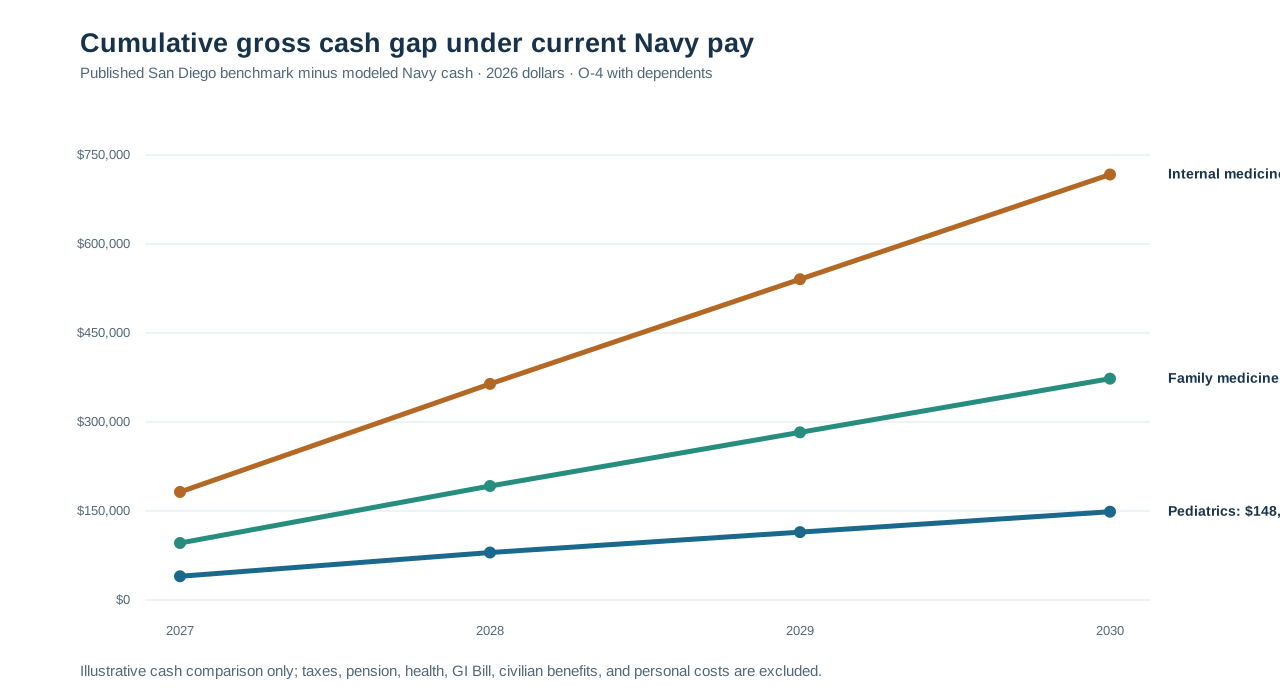
The civilian alternative is the physician’s opportunity cost of another Navy agreement. The published Marit San Diego figures imply Year 1 gross cash gaps under current bonuses of about $40,008 for pediatrics, $182,091 for internal medicine, and $96,072 for family medicine. These are useful starting observations, but the salary figures are citywide and mixed-employer. Gross cash also leaves out differential taxes, civilian employer retirement and health benefits, pension continuation value, GI Bill transfer, and expenses the physician would personally pay. The analysis table and figure remain the transparent cash baseline.
| Specialty | Year 1 current cash gap | Four-year current cash gap | PV at 5% |
|---|---|---|---|
| Pediatrics | $40,008 | $148,794 | $139,009 |
| Internal medicine | $182,091 | $717,126 | $668,019 |
| Family medicine | $96,072 | $373,050 | $347,749 |
These are cash-only benchmark comparisons, not exact opportunity costs or predictions of retention. Individual taxes, benefits, expenses, and actual offers could change them substantially.
The model should show (1) the present-value financial difference between the two paths, (2) its annual equivalent over expected additional service, and (3) the nonfinancial value the physician would need to place on Navy service for staying to be preferable under the current package. Assignment stability, protected clinical practice, family time, and mission matter, but their dollar values are not observed in salary data. Survey or choice data could estimate how preferences vary; absent those data, the nonfinancial figure is a required threshold, not an asserted benefit.
The interactive lab lets a physician compare a longer active-duty path with rising civilian earnings and, optionally, a civilian-plus-Reserve path. For example, someone at 10 active years can enter 10 additional years to reach active-duty retirement, then compare its pension with a possible Reserve pension based on qualifying years, retirement points, and pay-start age. The DoD active and Reserve rules distinguish eligibility and pension formulas; future Navy TSP contributions are entered separately. This sensitivity assumes completion of the chosen paths and does not assign a retention probability. It also does not model promotion, Reserve drill earnings, or different earnings after military retirement. The four-year Marit table above remains a cash-only starting point.
The staffing decision is current. GAO’s staffing review reports that assigned military medical personnel across DOD fell about 16% from FY2015 to FY2023 and that substantial shortfalls were expected through at least 2027. That is not a Navy primary-care retention rate. GAO’s incentives review reports that DOD lacks consistent replacement-cost, bonus-acceptance, and civilian-wage data needed to judge incentive effectiveness. The next step is to collect those inputs and evaluate the existing FY26 pay change alongside other retention factors.
The decision has two empirical steps. First, test whether accurate information changes acceptance and later retention relative to standard information. Second, establish whether any additional retained physicians fill Pacific-relevant billets or preserve deployable clinical capacity. Count a staffing or readiness benefit only when the corresponding outcome is observed; a modeled salary gap cannot supply that evidence.
Pay is not the only reason a physician stays. Predictable assignments and protected clinical practice may reduce the compensating wage differential required for Navy service. Public Medical Corps community values emphasize specialty practice and professional growth, while a 2026 GAO review describes clinical-readiness opportunities from civilian partnerships and gaps in activity data. Neither source quantifies a retention effect. Pension, healthcare, and GI Bill rights affect present value only when staying creates value beyond benefits already earned. The fixed cash table leaves those person-specific benefits unpriced. It also holds rank at O-4; a real promotion would change the pay comparison. The Marit benchmarks are self-reported, citywide, and mixed-employer; the especially high internist figure includes unlike career stages and a military-contractor entry in its public preview. The Doximity and SalaryDr national sensitivity checks show much smaller internist gaps, although SalaryDr’s internist median includes hospitalists. I would therefore treat the cash results as planning figures, validate them with comparable local offers, and estimate a range for the person-specific financial opportunity cost before setting any program-wide schedule.
White Coat Investor’s 2012 stay-or-separate essay reinforces the need to compare career paths rather than one year’s salary: retirement prospects, tax-adjusted pay, the ability to use civilian earnings sooner, and the location or deployment demands of service all affect the choice. Its personal account also names leadership, distinctive clinical work, and service as possible reasons to stay, which helps define what an accurate information campaign could describe. The 2012 annuity quote, taxes, and legacy pension example are not suitable FY26 values. Our four-year O-4 scenario does not reach 20 years, so its $0 pension entry cannot be read as a finding that four more years of service create no retirement option value. I would add a separate career-path sensitivity to retirement using the physician’s actual system and service credit before making that claim.
The 2019 White Coat Investor interview with Joel Schofer gives the communication proposal a concrete challenge: MCCareer.org already gathered scattered career information and job announcements. A new briefing must improve on what eligible physicians already know, with current and specialty-specific opportunities they can actually pursue. The interview also describes leadership and training alongside assignment uncertainty and clinical constraints. I would disclose both sides in the message and measure baseline awareness, rather than advertise only favorable examples. Schofer’s emergency-medicine experience and informal satisfaction impressions do not establish what today’s Navy primary-care physicians value or how their retention responds.
The peer-reviewed evidence favors testing the substance of those opportunities, not just their description. In an Army study that linked survey responses to subsequent voluntary separations, family well-being, predictability, and duty-station choice were associated with leaving. A separate military family-physician survey found that perceived fair compensation was not significantly different from civilian survey responses even though compensation differed; its 55% stated-or-past post-obligation retention figure is not a Navy outcome rate. Mentoring, administrative support and rank, and team coordination also appear in observational military studies. These findings support measuring actual access, family and assignment conditions, and career stage. They do not show that a briefing causes retention.
The added literature rules out treating communication as the established best policy. A transnational qualitative study calls for tailored combinations of support, education, pay, and workload changes. A review of reviews finds that turnover intentions are distinct from actual departures and that intervention evidence is context-dependent. State support-for-service data and a 2026 rural primary-care review make financial incentives a plausible alternative, though neither supplies a Navy bonus level. A new military postgraduate-education survey links education with stated likelihood of staying, not observed retention. The policy choice is therefore empirical: measure current pay and real opportunities, then compare changes in actual decisions and separations. The analysis evidence table records all 17 items and their limits.
Frank et al.’s Principles of Economics (4th ed., 2019) sharpens the decision rule. Opportunity cost and thinking at the margin (pp. 5–8) mean comparing the next Navy agreement with the best feasible civilian path, counting only benefits and costs that change. The inflation and saving chapters (pp. 324, 407–414) support constant 2026 dollars and a real discount rate for future pay and pension. The elasticity and labor-market chapters (pp. 73–80, 376–385) explain why pay might affect retention, but no textbook curve or salary gap estimates the Navy physician response. The course crosswalk maps the relevant chapters, including less applicable macro and trade concepts.
BUS 620 Session 1’s elasticity lesson (pp. 18, 24–30) requires an observed change in retention after a compensation change. The oil responses in that lecture cannot stand in for a physician response. Micro C6’s consumer-choice and indifference-curve lessons (consumer choice pp. 5–14; reading pp. 3–9) show that cash, assignment stability, clinical practice, and family time form a bundle. Equal gross cash does not prove indifference between jobs.
Micro C4’s marginal-cost and sunk-cost distinction (pp. 7–15) means a future policy analysis should count new spending and avoidable future costs, not HPSP or training money already spent. The “Who Paid?” lecture (BUS 620 Session 3, pp. 35–43) calls for separating Navy fiscal expense, physician compensation, and any measured patient-access or readiness gain. The current table cannot establish a cost-effective new bonus.
The obvious objection is that advertising cannot make up for a large salary gap or a harmful assignment. That may be right for many physicians. I would first verify that each advertised opportunity is available to the intended group, then compare targeted communication with standard information. Record whether a physician actually gets the promised mentoring, clinical work, or assignment option. Where feasible, compare communication with an operational improvement in assignment predictability or clinical access; retain financial changes as a separate policy option rather than assuming pay is unimportant. Measure accurate awareness, acceptance at an unobligated decision, and retention after the agreement. Analyze results by estimated financial gap, specialty, rank, and facility, while accounting for the existing FY26 internal-medicine pay change. Define the same post-obligation follow-up period for all groups, because accepting a longer contract is not itself durable retention. A change in stated intent alone would not establish a retention effect.
I would reject or narrow the communication hypothesis if accurate awareness improved but agreement acceptance and later retention did not, or if the advertised opportunities were not accessible in practice. If an actual assignment or clinical-practice improvement changed retention while communication alone did not, I would recommend the operational change. A weak effect among physicians with the largest verified gaps would also set a practical limit. I would revise the financial estimate if comparable local offers, taxes, benefits, or physician-paid expenses materially changed it. The current table does not measure the effect of communication or the value physicians place on nonfinancial attributes.
FY26 NAVADMIN 229/25 continues existing special-pay authority and directs officers to Medical Corps guidance. This memo models current FY26 rates for an eligible new four-year agreement. An individual’s existing agreement may carry another rate; verify contract vintage and eligibility before using the estimate.
The opportunity-cost estimate needs a total-compensation check before a dollar schedule is set. Navy cash already includes BAH and BAS, which DoD identifies as generally tax-exempt. An individual tax calculation could narrow the after-tax gap. Pension and BRS/TSP, TRICARE, and potential GI Bill transfer could add value only to the extent staying changes what the physician receives; already earned rights should not be credited again. Leave, clinical development, assignment stability, and mission value should be recorded alongside pay. A civilian offer may include its own retirement, health, leave, and malpractice benefits. I would use verified offers and physician-specific benefit inputs to estimate a range before deciding whether any policy change is warranted.
For evaluation, I would seek the annual provider-retention survey required by Section 718 of Public Law 118-159, alongside administrative records of bonus eligibility, acceptance, and eventual separation. The survey can reveal stated reasons for staying or leaving; the administrative records are needed to test whether the bonus changes behavior.
Source note. Preliminary internal survey findings signal retention concern, but they measure stated intentions rather than observed separations. Because the underlying briefing is controlled and has not been verified as publicly releasable, this public memo omits its figures. Obtain an approved aggregate release and match it to administrative retention outcomes before using those numbers as evidence in the paper.
Pay-plan baseline. The corrected FY25 Medical Corps guidance set the four-year general internal-medicine RB at $40,000 annually; FY26 guidance raised it to $48,000. Pediatrics remained $35,000 and family medicine $48,000. The modeled baseline is therefore a new FY26-rate agreement, not a claim about every physician’s existing contract. The evaluation should record agreement start year and actual RB/IP payments, and distinguish any effect of this existing $8,000 internal-medicine increase from concurrent changes.
Next sensitivity. FY26 Medical Corps guidance also lists six-year bonuses above the four-year schedule for these specialties. That current six-year agreement option should be compared only across a full six-year horizon, including the extra two years of obligation and the post-agreement retention outcome. For individual pension value, I would distinguish 20-year eligibility from student or training time credited in the retired-pay calculation, as described in the DoD USU credit memorandum, and verify the member’s Statement of Service. Neither refinement changes the current four-year gross-cash arithmetic.